Tuesday, 6 May 2014

Best Nokia Lumia 1020 Windows Phone SIM free deals for May 2014

Cellcom Communications
Cellcom Montreal
Bell 
Bell Mobility
Bell Mobile
Fido
Rogers
Telus
bell mobility
bell.ca
bell canada
rogers phones
rogers mobiles


The Nokia Lumia 1020 is the best selling high-end Windows Phone smartphone in the UK and combines a stunning 41-Megapixel camera PureView camera with a great design and amazing battery life. Check out the best Nokia Lumia 1020 Windows Phone SIM free price deals for May 2014.
The Nokia Lumia 1020 has proven to be so popular here in the UK that it remains the best selling smartphone on the Nokia UK website. That’s some feat when you consider that Nokia offers some pretty amazing smartphones. The handset is available to buy SIM free in a choice of three colours: Black, White and Yellow. We love the polycarbonate design, which not only looks great but also feels amazing in the hand.
The Nokia Lumia is based around a 4.5-inch AMOLED  that packs in a great 1280 × 768-pixel resolution touchscreen. You’ll find that is is made from Gorilla Glass 3, making it tough and durable, while the Nokia ClearBlack and super-sensitive technology make it the most touch-friendly and reliable in all lighting conditions. This all adds up to a display that is ideal for use indoors, as well as most importantly when you’re trying to get the perfect photo on the go.

Monday, 5 May 2014

world zombination (ios / android teaser trailer)

Cellcom Communications
cellcom internet
bell internet 
bell phones
bell mobility
bell.ca
bell canada
rogers phones
rogers mobiles
bell internet montreal
bell internet plans
telus phones
telus mobiles


Smartphones: The silent killer of the Web as you know it

Cellcom Communications
Bell 
Bell Mobility
Bell Mobile
Fido
Rogers
Telus
Mobile Phones
Mobile Contracts
Bell Satellite
cell phones
cell phone companies
cell phone

VATICAN-POPE-RELIGION-CATHOLIC

The PC is dyinglong live the PC! These headlines have been thrown around for years, as sales of laptops and desktops have continually dwindled downward.
The tablet has long been pinned as the murderer of the traditional computers and it certainly looked like it was going to be the one to do away with them (perhaps in a few years), with the focus of many companies such as Apple and Microsoft shifting towards a tablet-first world.
It’s obvious from the steadily declining shipments of traditional computers andcompanies exiting the PC market, that it’s not looking good for PCs, with tablets regularly eating into computer shipments year on year.
That was, until Apple reported in its last earnings call that it had actually sold fewer iPads than the previous quarter for the first time ever. The media is in a frenzy, wondering if the tablet isn’t the savior after all. From stories wondering ifApple’s iPad business is collapsing to others pointing to tablet demand hitting a wall, it seems that the world has suddenly realized that tablets aren’t  all they’re cracked up to be; perhaps they won’t outsell the PC after all.
But that’s not because tablets are dying, it’s because a deeper shift is underway that will fundamentally change the way the internet is used in the future.

The tablet bridge

487936701 Smartphones: The silent killer of the Web as you know it
Tablets have been on an insane trajectory for the last few years, but the rate of adoption was a little odd, compared with traditional uptake. According to twoseparate Pew Research studies, adoption has thus far been made up of:
16% 15-20 year olds with tablets
18% 20-29 year olds with tablets
25% 30-55 year olds with tablets
A post by Dustin Curtis this week pointed out that this is the exact opposite of how new technology is traditionally adopted, with older people adopting tablets must more rapidly than those that are younger. How can this be? Probably because the older generation ‘gets’ the tablet and “naturally extends” the function of the desktop/laptop computers they’re used to.
Benedict Evans also published a great, in depth look at iPad sales trends which sheds a lot of light on what’s really going on under the surface, which can be seen in the graph below. For example, iPhones are continuing to grow at an exponential rate, but the iPad is hitting a wall.
download Smartphones: The silent killer of the Web as you know it

The changing internet

180222210 Smartphones: The silent killer of the Web as you know it
Tablet growth being driven by the older generation actually points to a more interesting shift. There are two different worlds on the internet, which may not be apparent on the surface. The way that the older generation interacted with the internet was primarily through a Web browser or email client; these generations are accustomed to visiting websites and using search engines to find content and interact with others.
The over 30-age demographic grew up with desktop email, internet forums, chat rooms, instant messaging and message boards, where the the majority of the internet was experienced through a single application — the Web browser — which was the gateway to the world. Accessing the Web relied on this, and tablets are a natural extension of this behavior.
Tablets have a nice, large screen and are easy to use for these tasks since most desktop sites work reasonably well in their browsers. They have decent email clients. If this is the old internet, what does the new internet look like?
For the younger generation, the answer appears to be hundreds of small, single-purpose apps that work together seamlessly. Dustin points out in his piece that:
Young people are growing up on the mobile phone as their primary computing device, which has fundamentally changed the way they use and think about the internet
This is backed up by the data. Pew reports that 74% of teenagers use the internet from their phones and an increasing number of them are ‘cell-mostly’ users,with 55% of young users choosing to use only their phones. We’re living in a world where young smartphone users overwhelmingly choose apps as their way to access the internet.
Young people don’t use tablets because they don’t see them as necessary for accessing the internet, since their perception is that apps are what makes up the internet. They’ve grown up primarily using their phones, not using laptops with Web browsers. To this generation, it seems slow, purposeless even to go from website to website in a single, sub-par Web browser environment when they can get rich app experiences right from their home screen.
The older generations, who are more accustomed to the traditional Web, transition to tablets and predominantly use the Web browser and email client but download a few apps here and there, slowly transitioning into the modern app-first world, but not diving in head first.
The big players have started to notice this trend, so are moving quickly to adapt to a world where your app has to do one thing well but can work in unison with a range of their own apps and services.
Facebook was one of the first companies to notably start forcing its apps to be separate, smaller entities that live on their own. Messenger is now completely removed from the main application and requires a separate download. The alternative Paper app is a separate download too, along with its other properties, Instagram and WhatsApp.
Some of the largest smartphone success stories have started out as app-only, which further proves that this is the new way of interacting for young people. For many years, Instagram only had an iOS application and no Web counterpart. WhatsApp still doesn’t have a Web client, or a desktop app, instead choosing to stick to smartphones.
Others, such as Vine, Snapchat and Secret started life in the same way. There’s simply no need to create a browser-based version in many cases, as the target users of the younger generation users won’t ever miss it. There’s a now whole new class of internet that excludes Web browsers.
Twitter actually saw this coming some time ago, when it launched deep-linking of mobile apps inside its own applications. The value of smartphones is tied up in being able to smoothly jump between app experiences, but also allowing them to all communicate with one another.
Facebook only got around to releasing this same functionality this week, but it shows the direction it’s headed — more mobile apps — so the company has open sourced the technology. The numbers agree with this, too, with smartphone app installs climbing year on year to an average of somewhere between 40-60 apps installed per device.
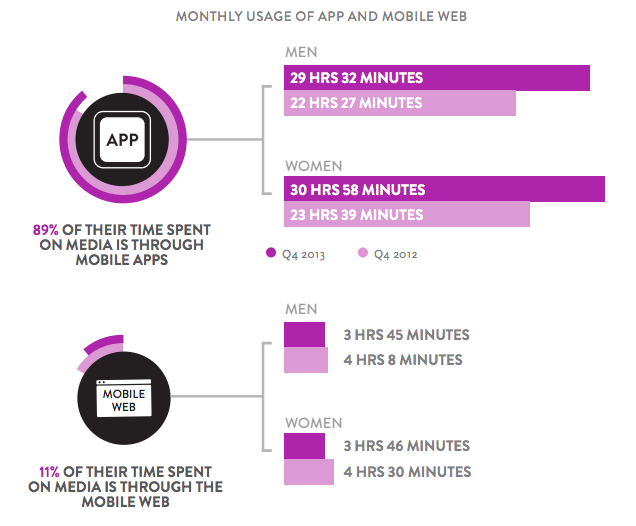
This number will only get higher as the younger generation gets older and continues to expect this to be the primary way to use the Web. As time goes by, mobile users are spending more and more time in apps and less time in browsers, according to Smart Insights.
Nielsenmonthlusagemobileappdevices1 1 Smartphones: The silent killer of the Web as you know it

The Web is evolving

All of this isn’t to say that tablets aren’t useful — they certainly are — but the most interesting thing about this trend is that the line between smartphone and tablet is quickly blurring, as the devices were more of a temporary solution to an evolving internet.
The average screen size for smartphones shot up to between 4.5″ to 5″ inches (despite Apple sticking to a smaller screen size) in 2014 which points to smartphones having been slightly too small historically and tablets having been too big.
As smartphones get bigger and tablet sales begin to shrink, it exposes just why tablets might have been so popular in the interim. Dustin put it eloquently that “the tablet is really just a temporary evolutionary sidestep that overcomes screen and battery technology issues in mobile phones.”
It’s true that many tablet devices run the same mobile OS’ as their smartphone counterparts, but surveys have shown that tablet users prefer the browser to native apps, which continues to confirm the idea that older generations have adopted them as the next evolution from their desktop devices.
Share of time spent consuming media Mobile Desktop chartbuilder 1 Smartphones: The silent killer of the Web as you know it
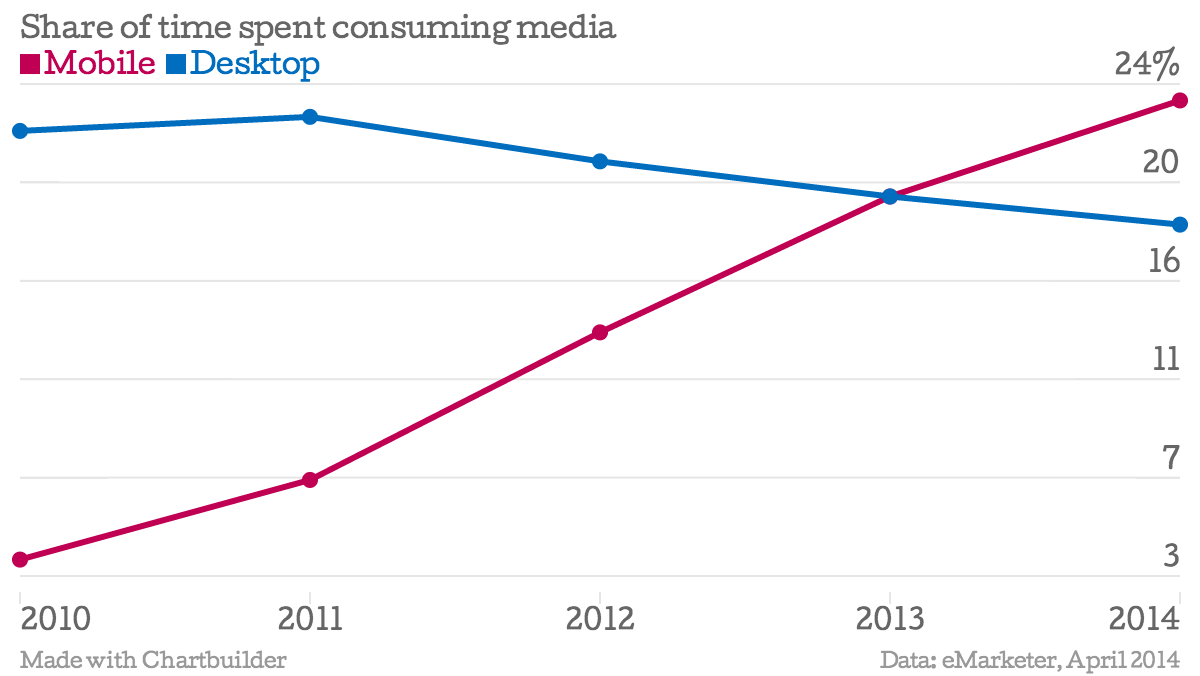
But to see where the next ‘big’ thing is, we must look to the younger generation, who overwhelmingly chooses mobile. In 2014, smartphone use is set to surpass that of traditional computer use, further pushing us into the brave new ‘app-first’ world.
As the younger generation grows up, we’ll see the focus will shift away from the tablet slowly to the devices that young people have been using their entire life; smartphones. It makes little sense to this new way of connecting to carry two devices, so expect to see the tablet market continue to shrink.
As battery life gets better and screen sizes grow, it’s likely tablets and smartphones will eventually just converge into one device that can be simply slipped into a pocket, instead of two devices that overlap each other in many areas.
This is already beginning to happen with iPad mini sales quickly eating into that of the larger iPads and will likely continue as Apple releases a larger smartphone later this year.
The internet of apps is upon us and it’s only a matter of time until the traditional internet is left behind.

Friday, 2 May 2014

Best smartphones of 2014 : iPhone 6 - Galaxy S5 - HTC One .

Cellcom Communications
Telus
Mobile Phones
Mobile Contracts
Bell Satellite
cellcom phones
cell phones
Bell Satellite
cellcom phones
cell phones


Samsung Galaxy Note II Reportedly Receiving Android 4.4.2 Update in India

Cellcom Montreal
rogers mobiles
fido phones
fido mobiles
bell internet montreal
bell internet plans
telus phones
telus mobiles
bell internet 
bell phones
bell mobility
bell.ca

samsung_galaxy_note_2_recieve_android_kitkat.jpg

A week ago, users reported Samsung had started rolling out the Android 4.4.2 KitKat update for its Samsung Galaxy Note II phablet in France. Now however, Galaxy Note II users in India have also begun reporting that their devices have started receiving the update.
The news comes via Twitter, where a Samsung Galaxy Note II user in India, @dinakaran, on Fridaytweeted he had received Android 4.4.2 update for the international GT-N7100 variant, with build number KOT94H.N7100XXUFND3, complete with a screenshot of the details. However, the mode of update (OTA or via Samsung Kies software) used was not mentioned.
The Android 4.4.2 KitKat update for the Samsung Galaxy Note II is said to bring several new features, like full screen album art; option to bring camera shortcut on the lock screen; transparent status bar; wireless printing functionality; NFC tap-to-pay support; option to set default messaging and launcher apps, and is also set to revamp the overall response time and speed of the phablet.
Users would be also receiving some Samsung goodies like the latest Samsung Knox and Samsung Wallet seen in the new Samsung's TouchWiz UI. The KitKat firmware for the Galaxy Note II was first spotted on Samsung's Kies PC suite software.
The Samsung Galaxy Note II phablet was launched with Android 4.1 Jelly Bean in August 2012. Some of the key features of the phablet are its 5.5-inch Super AMOLED HD display, 1.6GHz quad-core CPU and 2GB of RAM. The device also comes with an 8-megapixel rear camera, a 1.9-megapixel front camera and a huge 3100mAh battery on-board.
Couple of weeks ago, Samsung reportedly began rolling out the Android 4.4.2 KitKat update for itsGalaxy Note 10.1 (2014 Edition) (Review) tablet. As per the report, the update brought similar enhancements along with revamped sound controls.

Thursday, 1 May 2014

How to make an iPhone Dock for $1

Cellcom
bells stores
phone bell
Bell Store 
bell fibe TV
bell home phone
fido rate plans
bell.ca
bell canada
rogers phones
rogers mobiles
fido phones


High-End 'Silver' Smartphones May Replace Google's Nexus Program

Cellcom Communications
bell home phone
fido rate plans
fido contracts
telus contracts
telus rate plans
rogers contracts
Bell Mobile
Fido
Rogers
Telus
Mobile Phones
Mobile Contracts

The days of affordable Google-sanctioned Android smartphones like the Nexus 5 may be coming to an end. According to The Information (via The Verge), Google will reportedly replace its Nexus smartphone line with high-end handsets as part of its new "Silver" program.

nexus 5

The report suggests that the company will work with manufacturers and carriers to produce phones that "closely adhere to Google specifications." The alleged handsets may also be limited as to how many non-Google apps can be pre-loaded, or they will give users the option to delete pre-installed apps. LG and Motorola are said to have the highest chance of releasing "Silver" devices, which may lauch as early as next year.
At this point, it's unclear what would separate the new phones from Google Play edition handsets. Google Play edition smartphones—which have been offered by Samsung, HTC, and Sony—already exist as the respective manufacturer's flagship product equipped with the same version of Android found on the Nexus phones.
To get the "Silver" program started, Google purportedly plans to spend up to $1 billion to work with manufacturers to produce the smartphones. The devices will reportedly launch in the United States initially, and in-store Android kiosks may be used to show off the new products.