In a shocking turn of events, Apple and Android fans on reddit have joined forces to collectively boycott the unethical blocking of NFC payment system by certain retailers, which affects both Apple Pay and Google Wallet users.
If you're not aware, some of the retailers in the US have started disabling their NFC systems in their stores to prevent people from using Apple Pay or any other NFC based payment system. The reason for this is that these retailers are part of an organization called Merchant Customer Exchange, or MCX, which has its own payment system Called CurrentC.
Instead of a secure, wireless system, CurrentC requires users to download an app and fill in their debit card information in that. Then every time you have to purchase something you have to scan a QR code with the app, and then pay for it. The app is also used to shove promotional content and coupons to users, which they may or may not want.
Other than being inconvenient and annoying, CurrentC is nowhere as secure as either Apple Pay or Google Wallet. But having an alternate payment system is one thing. Blocking out competitive services entirely so that users have to either pay cash, card, or use CurrentC is another, entirely unethical and anti-competitive business strategy.
While the law would eventually come into the picture, people are now starting to boycott this practice. /r/Apple and /r/Android are fairly popular subreddits and if the two can actually come together and manage to get this done it will for the good of everyone.
I think that at some point in the future, smart phones will have a built in infrared camera. But for now, you are going to have to use an IR camera add on. This is the Seek Thermal infrared camera. What do I think about it? Let’s find out.
An Infrared Review
But what does an IR camera do? What can you use it for? Here is a more detailed overview of the physics of infrared light, but I will give you the short version.
Solid objects produce electromagnetic radiation. We like to call this stuff “light” (not to be confused with visible light).
When objects increase in temperature, two things happen. First, they produce more light. Second, the wavelength of light gets shorter. Note that they don’t just produce one wavelength, but in general the hotter the object the shorter the wavelength.
If you look at the wavelength of light (technically, the wavelength of the highest intensity light), you can get an estimate for the temperature of that object.
The best example is your stove element. Before you turn it on, it is room temperature and produces light. Just about all of this light from the element has a wavelength that is much too large for your human eyes to detect. Instead, you see the element because light reflects off the surface and enters your eye. If you turn on the element, it starts to get hot. Eventually, it will get so hot that you can see the light emitted since the wavelength is short enough to be in the visible spectrum.
So the infrared camera take the light that you can’t see and displays a false color image where different colors correspond to different temperatures (mostly).
Microsoft Research may have a solution for text input on small smartwatch screens, and it’s using Google’s Android Wear platform to test it out.
The company has developed an “Analog Keyboard” app for Android Wear, letting users string words together by drawing each letter on the screen. If you’ve enabled ADB for sideloading apps—that is, the same trick that lets you run Windows 95 on a smartwatch—you can download and install the keyboard from Microsoft’s Website.
Microsoft says its solution offers a few advantages over other potential text-input methods: Unlike a software keyboard, handwriting doesn’t require ultra-fine motor skills, and it even lets users write without looking at the screen. And compared to speech-to-text, handwriting is more discreet and less prone to background noise.
However, the current app has some limitations due to the computational load required. It currently can’t tell uppercase letters from lowercase ones, and it runs into problems with responsiveness. It also tends to be a battery hog. In the future, Microsoft hopes it can alleviate these issues by offloading some computation to a paired smartphone or to the cloud.
Why this matters: Even with Microsoft’s approach, the idea of writing an entire text message on a smartwatch seems kind of nightmarish. Still, the keyboard could be useful as an editing tool, letting users clean up any words that speech-to-text gets wrong. While there are no plans to release the keyboard as a finished product, with enough polish it might be a good fit for Microsoft’s existing OneNote Android Wear app.
The HTC One M8 is one of the best Android smartphones on the market right now, with the LG G3 and the Samsung Galaxy S5 as its main competitors.
According to a report from the Inquisitr, the HTC One M8 competes with the new iPhone 6 and the popular Nokia Lumia 1520 for the best overall smartphone for the holiday season.
The HTC One (M8) is HTC’s flagship, and one of the best Android smartphones on the market. Improving on the popular HTC One (M7), HTC continues its brushed metal design and has introduced its unique Sense UI 6 on top of Android. The 5-inch 1080p display meets the market standard, but the camera is where the HTC One (M8) stands out. Dual 4MP cameras with the unique 2µm pixel size offers great low-light photos. UFocus allows users to modify the focus point of the photo even after the photo has already been taken. The HTC One M8 also packs a Qualcomm Snapdragon 801, one of the fastest processors on the market, making it a very speedy device.
Similarly, the LG G3 sports a 5.5-inch Quad HD resolution screen. The phone also uses the Qualcomm Snapdragon 801 and has a 13MP camera. The speakers on the LG G3 are what set it apart: 1W speaker with 1.5W boost amp produces clear and loud sound. The HTC One M8 has front-facing speakers, still relatively new, but do not publish the specs of its speakers. The LG G3 also has a rear key for ambidextrous use. The button lays flat and is ergonomically designed for improved usability.
The Samsung Galaxy S5 comes in both dust and water resistant forms, making it the most durable of all three smartphones. The Samsung Galaxy S5 has a 5.1-inch Full HD display with a Qualcomm Snapdragon 801 processor and a 16MP camera. Sensors is where the Samsung Galaxy S5 excels, coming equipped with a fingerprint and a heart rate sensor for security and health. The Samsung Galaxy S5 also comes with a new ultra power saving mode for extreme cases where battery life is crucial.
All three devices come with microSD card slots that support up to 128GB. The minimum storage is 16GB for all three devices, but the LG G3 offers up to 3GB of RAM for those who need it while the HTC One M8 and the Samsung Galaxy S5 only offer 2GB. All three run on the newest Android operating system, Android 4.4.2 KitKat.
All three phones go for $199.99 with a contract. Without, the LG G3 goes for $460, the Samsung Galaxy S5 goes for $520, and the HTC One M8 goes for $555.
“iPhone 6 and iPhone 6 Plus will be available in India beginning Friday, October 17, from an expansive network of Apple Authorized Resellers. Customers can pre-order iPhone 6 and iPhone 6 Plus beginning Tuesday, October 7,” Apple India said in a statement today.
The company did not disclose the price at which it will sell iPhone 6 series in the country, but said, “Pricing details will be soon made available by Apple’s partners: Ingram Micro, Redington, Rashi Peripherals and Reliance.”
However, authorised Apple partners have given us a sneak peek into the pricing – 16GB, 64GB and 128GB iPhone 6 will be priced at Rs 53,500, Rs 62,500 and Rs 71,500 respectively. On the other hand, the larger iPhone 6 Plus will carry a price tag of Rs 62,500 for 16GB model, Rs 71,500 for 64GB and Rs 80,500 for 128GB.
Last week, Airtel listed the iPhone 6 Plus, the larger of the two devices, on its website, putting an end to all the drama surrounding the delayed India launch for the nifty Apple devices.
The authorized dealers will begin taking pre-orders next week and the device is expected to go on sale on October 17, as revealed earlier. This also means, like last year, the new iPhones will reach the Indian market just in time for Diwali.
It should be noted that when the iPhone 6 and iPhone 6 Plus page went live on the Apple website, it showed 26 September as the initial release date for India. The date was then changed to 17 October and after that the launch date completely disappeared and has found no mention on the page at all. Post all of this, rumours had gained traction that the India launch could be delayed until November.
Owing to the reports about a delayed launch, several iPhone 6 units had gone on sale in the grey market and selling at outrageous prices that went well over a lakh. However, as the buzz around Apple’s plan to start selling the device officially by mid-October or first week of November rekindled, there are several iPhone 6 units now selling online for under Rs 60,000 on some e-commerce websites.
The top two game apps on iOS and android that use a crossbow are Defender II and Shoot the Zombirds. These two games both generally fall into the Tower Defense type genre of games.
Defender II by Droidhen is the sequel to the successfully Defender. The main objective of the game is to defend your castle from waves and waves of enemies. To attack, you simply touch and point it to the direction of your targets. It will automatically shoot when your finger is pressed so no need to tap constantly. Aside from it, you will also gain access to spells which can decimate your foes. When enemies reach your castle, the castle's life is lessened. The game is over when it reaches zero.
Each level increases in difficulty and also the number of enemies to defend from. Some levels have bosses which will prove to be an additional challenge. As with its predecessor, you will gain crystals and coins after each level completed. These will enable you to upgrade your weapon. You can upgrade its various stats. Increasing strength will increase your damage. Increasing agility will increase arrow frequency. By unlocking also these stats, you will gain access to more skills and types of crossbow as well. Upgrading the mana tower will increase your mana for spells and it now also shoots your enemies.
New to this version too is the ability to deploy a lava moat before your castle. The lava moat will incinerate and torch all those enemies which fall to it. The biggest addition to Defender II is Battle mode. Now you can challenge other players to whoever survives the longest. Defender II is available free on iOS and Android with options to buy virtual currency to upgrade your skills and weapon.
Shoot the Zombirds by IDream is the successor to Shoot the birds. The gameplay involves you as Pumpkin head or boy shooting the undead birds in the sky and saving little pumpkids along the way. You tap to the direction where you will shoot.
Unlike Defender II which does not run out of arrows, this game does. It forces you to focus more on precision and timing rather than just careless shooting. You will not lose an arrow when you hit a target but will be lost when you miss. The level is over when you reach the number of pumpkids you can afford to lose.
There are fast and slow birds. Aside from birds carrying pumpkids, there are flying skulls which you can hit for gold coins. These gold coins can be used to purchase upgrades such as one time use powerups such rain of arrows or freezing all enemies on screen. You can use them also to increase the amount of arrows and the number of pumpkids you can afford to lose. Costumes are also available to be purchased if you want to change the look of your character.
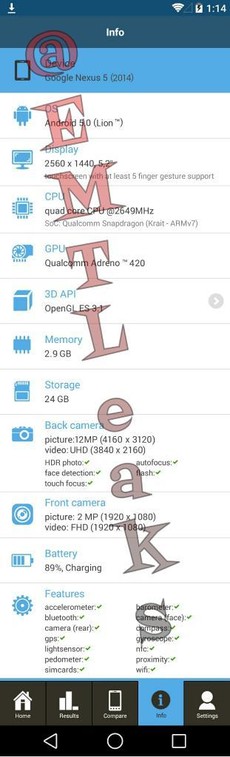
The new Nexus might just be called the Nexus 5 when it will be released, according to a benchmark test from GFXBenchmark and it might come with Android 5.0 Lion.
Is Android L going to be called Lion? We’ve no certainty of that and the following information should be taken with a grain of salt, but supposedly, Google might choose Lion as the identifier for the new Android OS. Lemon Meringue Pie and Lollipop might also be among the names Google is pondering upon, but we don’t know which is the one that will stick.
The Nexus 5 2014 was listed in the leak with a 5.2 inch Quad HD display, Snapdragon 805 clocked at 2.7 GHz, 3 GB RAM, 32 GB internal storage, a 12 MP rear and 2 MP front camera. So far, these are mildly impressing specs, the best feature of the Nexus 5 2014 being its Snapdragon 805 CPU. This device might also be the one we’ve been hyping about so much, dubbed Nexus 6, Shamu or even Nexus X, but it might as well be a wholly different device.
We suspect an Adreno 420 to be on board, since older Antutu Benchmark results showed the presence of the GPU in their listing. Wireless charging will also be among the features of the Nexus 5 2014, carrying it on from its predecessors. 4G and a fingerprint sensor might also be built into the device. Other rumors say that the gadget will sport a 5.9 inch screen instead of the 5.2 inch screen many are talking about. That would justify the Nexus 6 name for the handset, although that might raise copyright issues with a certain sci-fi author, Philip K. Dick (Do Androids Dream of Electric Sheep).
What’s most interesting about the new Nexus 5 2014 leak is the choice of Lion as Android L’s official name. If you think about it, the name might be a possibility, keeping in mind the previous partnership with Nestle, that brought us KitKat. There has been no word on Google’s part about what name the new Android OS will have when it is released, though.
Both Android L and the Nexus 5 2014 or Nexus 6 or Nexus Shamu or Nexus X, whichever name you choose to believe, will be launched sometime next month. The new Nexus 5 will probably be manufactured by either Motorola or LG, the scales tipping towards the first. There’s a lot of mystery surrounding the new Nexus device, so we will just have to wait another month to find out what’s really going on at Google.
Apple is launching the iPhone 6 on Tuesday 9 September. What features would you like to see?Photograph: Aly Song / Reuters/Reuters
Will it have a reversible USB cable? Are rumours of “unscratchable”sapphire screens true? And an NFC payment system? And just how big will the iPhone 6 be, exactly?
How about the rumoured wearable device? Is this the must-have exercise accessory you’ve been waiting for? Is your doctor pacing the floor impatiently, demanding your digitised biometric data? Or is this a long shot for Apple, and one you don’t care about?
Whatever Apple has planned will be revealed by CEO Tim Cook on Tuesday at Apple’s biggest launch event yet, with 2,500 people invited to the Flint Centre in Cupertino, California. The company is also expected to introduce its new iPhone and iPad software, iOS 8, which includes many new features focused around flexibility and interaction with Apple’s desktop and laptop computers.
You’ve heard the rumours – but what features would you like to see from the new iPhone? Are you happy with what you’ve heard about it so far? Or are there more design features Apple could add before you decide to buy? Let us know in the comments below and we may feature some suggestions above the line.
The first day of Gazelle's 53-day extended price lock on iPhone trade-in prices was Monday, and commitments to exchange the iPhone 5 and iPhone 5s subsequently surged 2,800 percent over the prior week. The iPhone 5 was the most popular on the cash paying site, representing 40 percent of all items traded in.
And for users planning to upgrade to Apple's latest and greatest, Gazelle is offering an exclusive deal for AppleInsider readers through Friday, Aug. 29th: when using this link (or the payout links below), Gazelle will pay out an additional $10 in cash over their standard value to anyone planning to trade in a current-generation iPhone 5s after the iPhone 6 is released.
Once the price is locked in, iPhones committed to Gazelle don't need to be shipped in a prepaid box until Oct. 10, which is a few weeks after Apple's next iPhone is expected to go on sale. Apple is widely believed to be planning a media event for Sept. 9, and if the company follows its typical release pattern, the "iPhone 6" would be in customers' hands beginning Friday, Sept. 19.
Customer excitement for the "iPhone 6" is expectedly high: Gazelle said it's seen nearly five times as many iPhones traded in over the last 10 days than compared to the 10 days before that. The iPhone 5 alone has seen its trade-ins spike 10 times over that same period.
Gazelle was handling nearly five offers per second at the height of traffic when the extended price lock took effect on Monday.
As can be seen in the AppleInsiderTrade-In Price Guide (relevant portion below), Gazelle is currently offering lock-in values up to $340 for previous-generation iPhones in flawless condition. With no need to send in the iPhone until Oct. 10, users will likely be able to purchase and set up their "iPhone 6" before needing to drop their handset into one of Gazelle's prepaid shipping boxes.
I have been using the HTC One M8 for the past five months and the HTC One M8 for Windows for the past week. It has been a fun week to test out both side by side and discover the differences between the two since we have never had this opportunity with the same hardware on these two operating systems.
Regular readers know I enjoy using Windows Phone and was one of the first to get hands-on with the operating system back in 2007. The OS has come a long way since then, especially with the latest 8.1 update that brings Cortana, Action Center, and more.
HTC's Sense UI on Android has also evolved significantly over the last couple of years and the One M8 running Android is one of the best smartphones available today.
Let's take a closer look at how the two devices compare.
PIM: The calendar is much more functional on Windows Phone, the combined inbox is more efficient, and the integration of OneNote is much better.
Voice control: Cortana blows away Google Now, and Siri, with very useful functions and consistent reliability.
Battery life: While the Android M8 gets me through a full day, the Windows Phone model regularly showed about 20 percent more capacity. I imagine it is because there is a lot more going on in the background on Android than WP.
Live tiles: I like the widgets on Android, but honestly I find the Live tiles to be more efficient at providing glanceable information.
Apps: Windows Phone has gotten better, but I need Android to connect to my UP24 and Pebble and use apps such as Pocket Casts, MLS Matchday, Chrome, Regal Cinemas, Runkeeper, and more. WP is getting better, but it is just not there yet.
Sense 6 UI: HTC has put a lot of effort into Sense and it is nearly perfect on the M8. It is not an overwhelming experience, yet makes Android better for most users. BlinkFeed integration is actually helpful and I use it all the time, even though I consider myself a power user.
Zoe: The new Zoe service just launched on Android and may come to Windows Phone. At this time, it is an advantage for the M8 with Android.
Both are excellent choices and if I was on Verizon I would personally pick up the Android model, primarily for the application selection and ability to connect to my accessories. However, the Windows Phone version is compelling because of better core support and Cortana integration.
Leaked photos, back plates, bezels and case-maker “dummies” have given us confidence of dimensions and some of the design details of the next iPhones. As we move closer to September 9, it is an article of faith among AppleAAPL+0.73% watchers and the easily convinced general public that there will be two models, the 4.7″ iPhone 6 and the 5.5″ iPhone 6L phablet.
Information about exactly how many pixels those 4.7″ and 5.5″ screens will contain and how new and existing iOS apps will make use of the extra real estate has been far less certain. Two developments in that aspect of the story this week give us the most detailed answers yet to those questions. Along the way we have also discovered a possible bit of Apple misdirection designed to throw the faithful off course.
The first piece of the puzzle—and the source of the apparent head fake—emerged from deep in the bowels of the Xcode 6 Beta 6 release that third-party Apple developers, myself included, got access to last Monday. Hidden ten levels deep in the file hierarchy, 9to5Mac’s Mark Gurman discovered a file in the updated iOS Simulator called “DefaultIconState-414w-736h~iphone.plist.” Gurman understood that this was evidence of a new screen format. What exactly it specifies is a matter of debate. To understand the possible implications requires a little bit of geeky iPhone lore.
In the beginning was the iPhone, and it was small. The original iPhone, the iPhone 3G and 3GS possessed a mere 480 by 320 pixels.And then Jobs said, let it be retina! And it was, and it was good with twice as many pixels in the same 3.5″ screen size. The iPhone 4 and 4S had 960 by 640 pixels. Alas, Jobs passed on but, lo, the iPhone rose on high! The iPhone 5, 5S and 5C all have 1136 by 640 pixels. Stretching the iPhone 5 to a 16:9 proportion had a big impact on how app designers used the larger available space, but it was less of a conceptual leap than the pixel doubling of the iPhone 4. From that point on, Apple’s “retina” devices had 2x pixels multiplied by the base “points” of the native device. So up until September of 2012, all iPhones were designed on the basis of 480 by 320 point proportion, with graphics rendered at 2x resolution for the later models.
So in the lead up to the iPhone 6, many have wondered if the large screen 6 series would be the occasion of an historical tripling of the resolution based on the iPhone 5 proportions of 568 by 320 points. Gurman had based an earlier prediction on this premise and reported that Apple was testing iPhone 6 units with a resolution of 1704 by 960 pixels. Both of Gurman’s theories seemed to suggest that the two new iPhone sizes would have identical pixel counts, following the example of the iPad/iPad Mini lines.
Friday, a second puzzle piece clearly shows a different and more nuanced story thanks to John Gruber, the Apple blogger who writes under the moniker Daring Fireball. In his post, “Conjecture on Larger Screen iPhones,” Gruber wields some fearsome middle school math to show that Gurman’s own conjectures are either wrong or only partially true. My colleague Ewan Spence discussed Gruber’s conclusions in a post yesterday, so I won’t belabor the details. Bottom line, the Gruber conjecture is that the two devices will have both different pixel dimensions and different retinal multipliers. To quote Gruber:
4.7-inch display: 1334 × 750, 326 PPI @2x
5.5-inch display: 2208 × 1242, 461 PPI @3x
Yes, I know, Spence already brought this up in these pages, so what more is there to add? Actually quite a lot. Gruber may not be exactly right about the pixel counts, but the reasoning behind his calculations is knowing and on target. Gruber is a true Apple insider, but he goes out of his way to say that “No one who is truly ‘familiar with the situation’ has told me a damn thing about either device.” In the next breath, 0f course, he goes on to mention that, “I have heard second- and third-hand stories, though, that lead me to think I’m right.” Gruber is an engaging writer, but he is worth listening to because he has followed Apple so long and so deeply that knows what is “Apple-like” and what is not.He could rightly be called Apple’s Boswell .
Hardware specs aside, what is so right about the “Gruber Conjecture”? It obeys Apple’s first principles of user experience. Yes, keeping things simple for developers is nice, and yes, going from 640 pixels wide to 960 pixels wide has Pythagorean simplicity to it, but in the end the most important reference point is the physical fact of the user. Apple’s point proportions are based on the scale of the human finger and the minimum size of a touch point is defined as 44 points. On a retina 2x device that minimum will be 88 pixels, but it is still represented as 44 points. The second important human factor (as Apple’s design guidelines are known) has to do with the acuity of the human eye at the relevant distance at which a device will be viewed. Apple considers a device screen retina if the pixels are small enough at a normal viewing distance such that the individual pixels are not distinguishable by the naked eye. For the iPhone this was originally defined as >300 pixels per inch with a target of 326 pixels per inch. A device, like a desktop computer, that one may normally view from more than a foot away can have a lower density and still be technically retina, but 300 PPI is a widely respected standard.
First, it is worth saying that there are many people who really like the current form factor and will be curious to see if bigger really is better. But assuming you are actually interested in one of the larger iPhone models, one of the key questions has been how will the extra pixels most likely be used, to scale up touch targets or to add functionality? I asked this in another way last week in my post last week, “Will Big Battery In 5.5-inch iPhone 6L Buy Full HD Video Or Just Less Wall Hugging?” Gruber answers with a resounding BOTH! As devices get larger we expect larger touch targets but we also expect more content. And there is a ratio to these expectations that Apple strives to maintain as it has embraced three aspect ratios and two scaling multipliers among its growing fleet of iOS devices. Despite this apparent fragmentation, Gruber is adamant that what Apple has “ never done, and I believe never will do, is redefine the virtual point to something other than 1/44th the recommended minimum tap target size for every device.” All righty then!
But what about how the new larger devices will abandon the sacred Jobsian tenet of one-handed usage? Will this change cause a move away from top navigation in favor of bottom navigation, for instance? As a case in point, have a look at the way Internet Explorer 11 for Windows Phone renders websites with no top address bar. I asked designer Jeremy Olson at Tapity (maker of theHours time tracking app that I reviewed recently) what he thought about this possibility. “That is a huge question,” he replied. “Apple’s main navigation paradigm is built around a bar at the top. The iPhone 5 already made it a bit of a stretch to reach that top bar with your thumb when you used the device with one hand. I use my phone with one hand all the time and I can’t imagine how I would navigate a lot of current apps on a taller screen. Apple, however, has already been educating developers to use things like optional gestures to help users navigate between views without having to reach up for that nav bar at the top. So even now, instead of reaching for back button at the top, you can swipe to the right to navigate back. I don’t think Apple’s top-bar dominated design paradigm is going away but I think more and more developers will need to augment it with optional gestures or bottom navigation to accommodate one handed use.”
There are several important points within Olson’s response. With all of these changes, Apple has been trying to move developers in the direction of gesture support and flexible sizing now for years. This year’s World Wide Developers Conference placed a lot of emphasis on the use of vector graphics and auto layout to make universal iPhone apps regardless of scaling. Gruber writes that:
Apple has already started encouraging iOS developers to begin using adaptive layout techniques. See session 216 from WWDC 2014: Building Adaptive Apps with UIKit. What’s telling when you watch that session and read the documentation is that developers should clearly anticipate new aspect ratios (whether for new displays, or for a still-hypothetical but rumored split-screen multitasking on future iPads) and physical sizes…
Olson concurs that, “When talking to developers, it seems Apple has been going more and more for unification rather than fragmentation. I think marketing your app as ‘enhanced for iPhone x’ will be discouraged. Rather, I imagine that Apple would like to see developers use auto-layout (a tool that allows developers to make their apps mold to different screen sizes automatically) to ensure that their apps work really well on nearly any screen size. While Apple obviously didn’t confirm any rumors about new form factors during their latest World Wide Developers conference, they emphasized using auto-layout like never before.” Olson points out that this message, “was even more clear when developers opened up the latest version of Xcode to see that the default window for building interfaces is no longer a portrait iPhone, but a square. Apple no longer wants developers to stop thinking about designing apps at a particular screen size, and start to think how to make their interfaces size-agnostic. It even goes back to when Apple went away from rich, skeuomorphic interfaces and moved to a simpler design aesthetic. It is a lot easier to stretch a flat button than it is to stretch a button that looks like a physical object.” For a long time, iOS app developers had the luxury of fixed screen sizes, but now they find themselves in a world not dissimilar to their counterparts who make responsive designs for the web.
Another interesting point relating to number of pixels vs. battery size is relevant to Gruber’s proposal that Apple will handle the screen resolution of the iPhone 6L phablet in a radically different way than the now midsize iPhone 6. With the 6L Apple will buy both more-than-HD video and less battery-busting “wall hugging.” And all this at an “amazingly sharp” resolution of 461 pixels-per-inch. So there, Samsung! Gruber even says he’d wager that, “Apple comes up with a new marketing name for it: super-retina or something.” Meanwhile, the 4.7″ iPhone 6, which has a considerably smaller battery than the 6L, would maintain the current 326 PPI that has been Apple’s retina standard for the iPhone, but would add an extra 38% to the screen area of the current iPhone 5 line.
The 68% increase in screen real estate combined with a 41% increase in resolution—and maybe even a sapphire screen—should easily justify the rumored $100 up-charge that Apple is expected to levy on its iPhone phablet. The production demands of all that may mean that the 6L will be announced on September 9 with the 6, but the actual phones may not be delivered until later in the fall.
But wait, what about that devious misdirect that Apple may have foisted on developers in Xcode 6 beta 6? Well, you see, in the same iOS simulator directory that contains the 736 by 414 point format, there is also a file titled, “DefaultIconState-568h~iphone.plist.” This is the screen format for the existing 4″ iPhone 5 series phones. By placing the 736 by 414 pixel format in the iOS simulator, Apple would seem to be indicating that there will be only one additional format and that thus, somehow, the 4.7″ device will have a 2x resolution of 1472 by 818 pixels. Only half true according to Gruber! Yes, the 6 will be 2x, but based on a new 667 by 375 point format. And the 736 by 414 point format in the present Xcode release will be the basis of the 3x 6L, weighing in at 2208 by 1242 pixels. (We will be looking for evidence of that“DefaultIconState” file in the next release of Xcode!)
The reason why the 6L will not be, for instance, 1565 by 880 pixels, maintaining 326 PPI, is that on a larger device we want the touch targets to be bigger. The iPhone screen resolution equation is in fact a three-factor optimization, as Gruber lays it out here:
Content area: showing more points on screen.
Scaling factor: the number of points per inch.
Sharpness/quality: the number of pixels per inch.
As such, a simple linear solution will never be optimal. So for app developers, the challenge is to make use of the larger screen area afforded by the new iPhone models but to continue to base designs on established human factors. Designers will want to make expanded use of gestures, particularly as alternatives to out-of-reach top navigation. The “DefaultIconState” files are merely lists of default icons, and that list is the same for the current iPhone (586h) as for the new format (414w-736h), but they don’t specify how those icons will be arrayed on the home page (aka the springboard) of the 6 or 6L. Following the iPad’s lead, It is possible that that Apple’s human factors engineers have determined that four icons across is optimal for a mobile device in portrait mode, no matter the screen size. Although, by Gruber’s logic, the 6L could make the springboard icons both larger and more numerous, in terms of usability, more may not be more. As I wrote in a very popular post back in February, “Will Apple’s iPhone 6 Phablet Push The Usability Of iOS To A Breaking Point?,” even the existing amount of icons per screen leads to more hunting around and swiping for deeper screens than is ideal.
Instead of adding more clutter, app designers and Apple itself should use the growing need for flexibility between screen sizes to introduce new organizational and navigational paradigms that are more about immediate intuitive gesture than about more elaborate hierarchies or more crowded arrays. Even though Gruber’s predicted iPhone 6 height surpasses the 2x retina iPads, Apple is indicating that the phone experience and the tablet experience are unique. The 6L will obviously be pushing that boundary, and it is now up to developers, both inside and outside of Apple, to make sure that the new kid doesn’t, in fact, break the usability of iOS 8.
As part of the push toward hardware flexibility that Microsoft announced in February, seventeen third-party Windows Phones are now either in production or will be announced shortly, a senior Microsoft executive said late Wednesday.
And the hope is that more are on the way.
Microsoft and HTC unveiled the HTC One (M8) for Windows earlier this week, a carbon copy of the Android version of the phone that HTC announced in March. So far, it’s the most high-profile indication that Microsoft's getting any traction from its more open policy toward third-party hardware, which the company announced at Mobile World Congress in February.
“We think people like choice, and will appreciate having that choice,” said Greg Sullivan, the director of Windows Phone at Microsoft, in an interview this week.
“While this is the first flagship [phone], we’re open for business,” Sullivan added.
MARK HACHMAN
The HTC One (M8) for Windows has almost all of the same hardware as the Android version.
According to Sullivan, Microsoft’s thinking changed from Windows Phone 7, when the company felt it had to, in Sullivan’s words, “take responsibility for the end user experience”—all of it, including “strongly prescribed guidance” about how those partners could implement the Windows Phone hardware. That included a mandatory hardware camera button, for example.
Microsoft launched Windows Phone 7 in October, 2010. It’s hard to believe now, but the leading smartphone platform maker in the United States then was RIM (now BlackBerry), with 35.8 percent, according to comScore. Microsoft with Windows Phone was fourth, with just under 10 percent, in a smartphone market otherwise divided between RIM's BlackBerry, Apple's iOS, and Google's Android.
By February, 2014, Microsoft’s market share had fallen to 3.4 percent, and Android had risen to a commanding 52.1 percent of the market. With hardware makers snapping up the free Android OS while Microsoft’s market share fell further and further, Microsoft needed to make a change.
At MWC, Microsoft’s attitude shifted: Instead of asking hardware makers to design for Windows Phone, Microsoft would implement changes designed for them. Microsoft now supports three popular Qualcomm SoCs, as well as easy-to-build reference designs based upon them. Microsoft also said it would allow soft keys in place of dedicated hardware buttons, as well as dual-SIM designs to accommodate phones released overseas. And the first Windows Phone 8.1 update, now available via Microsoft’s developer program, supports “smart covers,” like the HTC Dot View cover for the One (M8).
HTC
HTC's Dot View case shows who is calling. Users can also call upon Cortana by sliding a thumb down the case.
All this had an effect on hardware makers like HTC, which planned to release a Windows Phone version of the One (M8) all along, according to Jeff Gordon, the worldwide communications manager for HTC. And both Microsoft and HTC were interested in making it happen. The delay, he said, was due to “engineering resources that were still ramping up”.
Microsoft’s Sullivan said those resources included several dedicated HTC engineers who worked onsite at Microsoft, directly with the engineering team. “And I think the onus was on us to enable our software to do what we need to do on this device,” he said.
ICROMAX
“This is absolutely a change we’re embracing and encouraging,” Sullivan said of the new program to bring Android phones to Windows Phone. “It’s been interesting to see that of these 17 devices that have been announced or are available, most of them are for emerging markets or are lower-cost devices. But we’ve always known that there is this spectrum of devices that this would range from all the way from affordable devices up to the marquee and high-end devices like the HTC One. While this is the first flagship, we’re open for business.”
One particular aspect of Windows Phone, for now, remains sacrosanct: the user interface, which Sullivan called “one of the core things that sets us apart.” In other words, don’t expect a Windows Phone skinned in the style of HTC’s Sense interface.
For the last few years, however, the Windows Phone hardware ecosystem has been the Nokia Lumia line and not much else. A little variety, Microsoft hopes, could be the spice that livens up the moribund Windows Phone market.